






 December 26, 2025
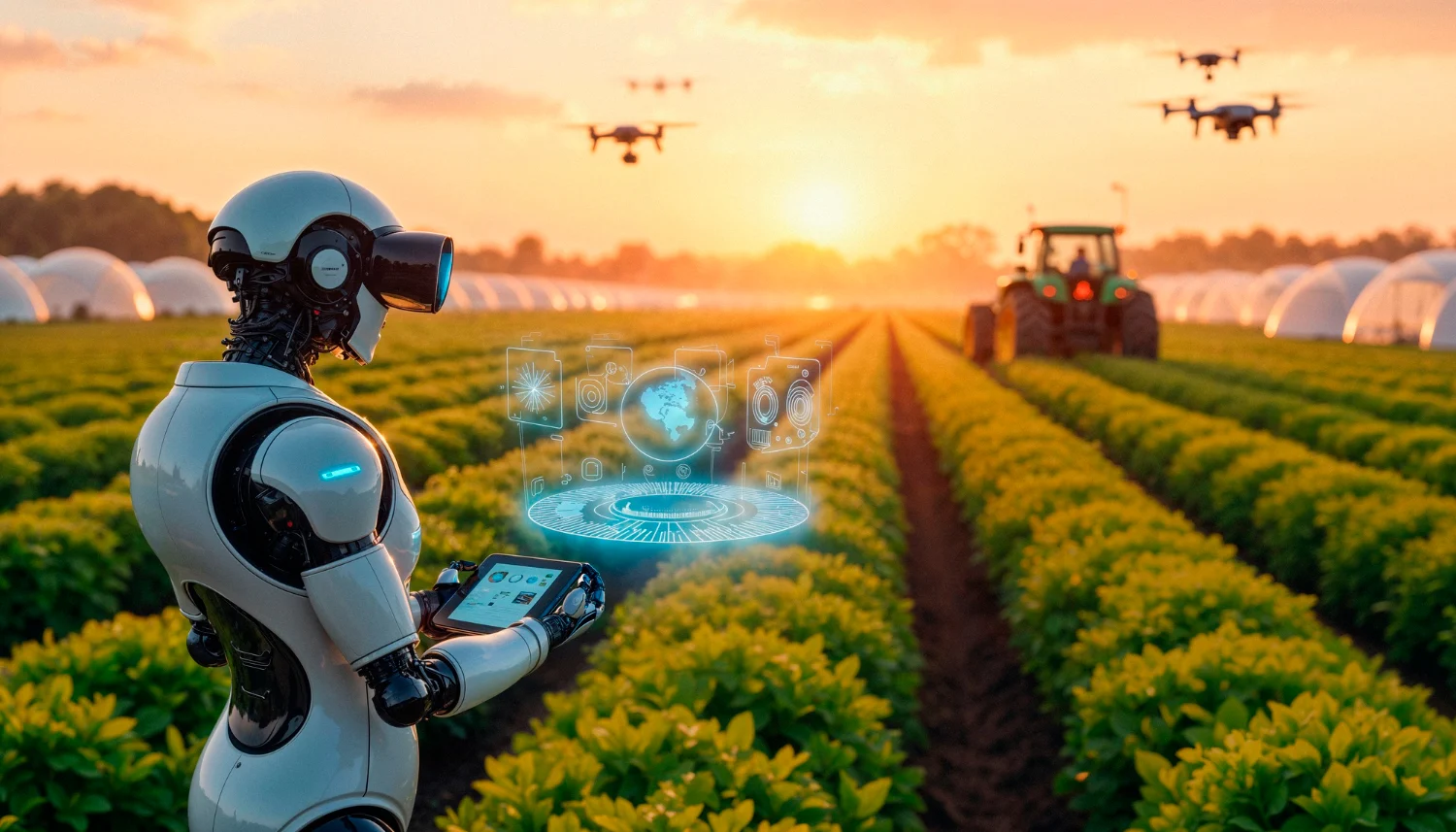
Farming is rapidly evolving from traditional practices to data-driven, technology-enabled agriculture. Precision agriculture is at the center of this transformation, helping farmers increase productivity, reduce input costs, and farm more sustainably.
In 2026, advanced technologies such as artificial intelligence, IoT, drones, and automation are reshaping how crops are grown and managed. This blog explores the latest precision agriculture technology trends that are transforming farming in 2026.
Precision agriculture is a modern farming approach that uses technology, data, and analytics to manage crops at a micro level. Instead of treating the entire field uniformly, farmers apply water, fertilizers, and crop protection inputs only where and when they are needed.
This targeted approach improves efficiency, reduces waste, and enhances overall farm productivity.
Artificial Intelligence is becoming a core component of precision farming. AI-powered systems analyze soil data, weather patterns, crop health indicators, and historical yield information to generate accurate recommendations.
These systems help predict pest and disease outbreaks, optimize irrigation and fertilizer schedules, and improve yield forecasting. AI enables farmers to make faster, smarter, and more profitable decisions.
Internet of Things sensors are widely used to monitor soil moisture, temperature, humidity, and nutrient levels in real time. The data collected by these sensors is transmitted directly to mobile applications or farm dashboards.
Real-time monitoring helps prevent over-irrigation, reduces nutrient loss, saves water and energy, and improves overall crop health management.
Agricultural drones are transforming how farmers monitor their fields. Equipped with high-resolution and multispectral cameras, drones provide quick and accurate insights into crop conditions.
They help identify pest and disease stress early, analyze crop growth and canopy health, and support field mapping and yield estimation.
GPS-enabled tractors and autonomous farm equipment allow precise operations such as seeding, fertilizing, and spraying. Automation improves accuracy and reduces human error.
These technologies result in better input application, reduced fuel and labor costs, and improved field coverage.
Variable Rate Technology enables farmers to apply fertilizers, seeds, and crop protection products at variable rates based on field-specific data.
Instead of uniform application, this approach reduces input wastage, improves nutrient use efficiency, and lowers overall production costs.
Precision irrigation systems use sensor data and weather forecasts to deliver the exact amount of water required by crops. Automated drip irrigation and smart sprinkler systems improve water-use efficiency significantly.
Soil moisture-based irrigation control ensures crops receive adequate water without excess use.
Satellite imaging provides large-scale insights into crop health, vegetation levels, and soil conditions. These tools are especially valuable for large farms and agribusiness operations.
They support early stress detection, seasonal crop performance tracking, and better planning and forecasting.
Digital farm management platforms allow farmers to monitor crop cycles, track input usage, record weather data, and analyze yield performance.
These tools simplify record-keeping and support data-driven decision-making across the entire farming operation.
Robotic technologies are increasingly used for precision weeding, automated harvesting, and crop scouting. Automation reduces labor dependency and improves operational accuracy.
Robotics also helps maintain consistency and efficiency in large-scale farming operations.
Precision agriculture supports sustainability by reducing chemical use, conserving water, and lowering carbon emissions. In 2026, climate-smart technologies help farmers adapt to changing weather patterns and climate risks.
These innovations make farming more resilient and environmentally responsible.
Precision agriculture helps farmers achieve higher crop yields, reduce input costs, improve soil and water management, enhance environmental sustainability, and increase overall farm profitability.
Precision agriculture is no longer a future concept—it is the present reality of modern farming in 2026. With advancements in AI, IoT, drones, automation, and data analytics, farmers can produce more food using fewer resources while protecting the environment.
Adopting precision agriculture technologies empowers farmers to remain competitive, resilient, and profitable in an increasingly challenging agricultural landscape.
We make it our business to advance your business. Get in touch to find out more.
ANBR ELIXIR PVT LTD
PLOT NO. 5144, NEAR PRIME INDUSTRIES, SEVEN WATER TANK ROAD,
NEAR PARAS CHOWKDI, G.I.D.C. INDUSTRIAL ESTATE,
ANKLESHWAR – 393 002.
DIST. BHARUCH, GUJARAT
ANBR ELIXIR PRIVATE LIMITED
Plot No. 10008-3, Near BEIL,
GIDC, Ankleshwar,
Dist :-Bharuch, 393002, Gujarat